The information on this website is general in nature and does not take into account your objectives, financial situation, or needs. Consider seeking personal advice from a licensed adviser before acting on any information.
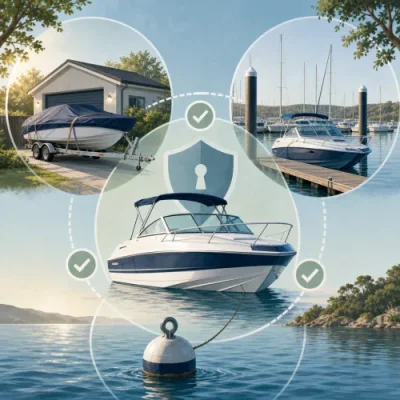
Where your boat is kept, how it is secured and how it is transported can affect boat insurance cover, exclusions and claims. This guide explains common storage, mooring, trailering, navigation and lay-up conditions Australian boat owners should check before they rely on a policy.
Boat insurance is not only about what your boat is worth or what happens while you are out on the water. Many policies also include conditions about where the boat is stored, how it is moored, whether it is kept on a trailer, where it may be navigated and what happens during off-season lay-up periods.
These boat insurance storage conditions can matter at claim time. A policy may respond differently if a boat is stolen from a driveway, damaged at a marina, breaks free from a mooring, is involved in a road accident while being towed, or is used outside the policy's navigation limits. The details vary between insurers and policies, so Australian boat owners should read the Product Disclosure Statement, policy schedule and any endorsements carefully.
This article explains the main clauses and practical questions to check. It is general information only and does not take your personal objectives, financial situation or needs into account.
Why storage, mooring and trailering conditions matter
Insurers assess risk based on how and where a boat is used and kept. A boat stored in a locked garage may present a different theft and weather risk from a boat left on a street trailer, a swing mooring or an exposed berth. A trailer boat used on inland waterways may also present different risks from a yacht kept at a marina and sailed offshore.
Because of this, a boat insurance policy may include conditions covering:
- the declared storage address or usual mooring location;
- the type of storage, such as home storage, dry stack, marina berth, swing mooring or hardstand;
- security requirements, including locks, wheel clamps, hitch locks, gates or alarms;
- whether the boat, trailer and accessories are covered while in transit;
- navigation limits, including offshore distances or named waterways;
- storm preparation, maintenance and seaworthiness obligations;
- lay-up periods when the boat is not intended to be used.
If the circumstances on your application are inaccurate or change after the policy starts, cover may be affected depending on the policy wording, the insurer's criteria and the facts of the claim.
Key fine-print terms to check before focusing on location
Before looking specifically at storage and mooring, it helps to understand the wider policy structure. These terms often interact with storage and transport conditions:
- Insured property: Check whether the hull, motor, trailer, tender, sails, electronics, fishing gear, safety equipment and personal effects are included, excluded or subject to sub-limits.
- Agreed value or market value: The method used to value the boat can affect the amount payable after a total loss, subject to the policy terms.
- Excess: Some policies may apply different excesses for theft, racing, named weather events, mooring damage or other events.
- Exclusions: Common exclusions can include wear and tear, gradual deterioration, lack of maintenance, vermin, corrosion, mechanical breakdown, intentional damage or use outside policy conditions.
- Policy schedule: The schedule may record the boat's usual location, mooring type, navigation area, use and insured items. This document is just as important as the general wording.
For a broader overview of marine cover options and quote considerations, you can visit Boat Insurance Online.
Home storage: garages, driveways, yards and private property
Many trailer boat owners keep their vessel at home. This can be convenient, but it does not automatically mean every theft, storm or damage scenario is covered. The policy may distinguish between a locked garage, a fenced yard, a carport, an open driveway or a boat parked on the street.
Security requirements
Boat insurance storage conditions may require reasonable security when the boat is not in use. Depending on the policy, this could include keeping the trailer locked, using a hitch lock or wheel clamp, storing keys separately, securing removable equipment, or keeping the boat behind locked gates.
If theft occurs and the required security measures were not in place, the insurer may consider whether a policy condition was breached. The outcome depends on the policy wording, evidence and individual claim circumstances.
Weather exposure at home
Home storage can also raise weather issues. A boat left uncovered under trees, in a flood-prone area or unsecured before a forecast storm may be treated differently from one properly covered, drained and secured. Some policies require the owner to take reasonable precautions to prevent loss or damage.
Australian weather can change quickly, particularly in coastal and storm-prone regions. For practical preparation ideas, see the related guide on securing your boat against severe Aussie weather.
Accessories and removable equipment
Even if the boat itself is insured, portable equipment may have different rules. Fishing gear, electronics, life jackets, eskies, tools and personal items may need to be locked away, listed on the policy or subject to sub-limits. Do not assume items stored in the boat at home are covered in the same way as the hull.
Marina berths, dry stacks and hardstand storage
Marina storage can reduce some risks and increase others. A secure marina may offer monitored access, fire systems and professional handling, but boats can still be exposed to storms, collision, theft, electrical faults, sinking or damage caused by nearby vessels.
Declared marina or storage facility
Some insurers want to know the exact marina, storage yard, dry stack operator or hardstand facility. If the boat is moved to a different facility, especially for an extended period, you may need to notify the insurer. Temporary haul-out for maintenance may be treated differently from a permanent change of storage location.
Berth and facility obligations
Your marina agreement may also impose responsibilities around mooring lines, fenders, shore power, inspections, waste, fuel, weather preparation and emergency access. These are separate from your insurance contract, but both may matter if damage occurs.
For example, if a vessel is damaged because lines were badly maintained or shore power was left in an unsafe condition, the insurer may review whether reasonable care and maintenance obligations were met. Policies differ, so it is worth asking how the insurer treats marina-related incidents.
Damage caused by other boats
If another vessel damages yours while berthed, your own boat insurance may still be relevant. The insurer may assess your claim under your policy and then consider recovery from another party if appropriate. Liability and recovery processes can be complex, so keep photos, incident reports, marina correspondence and witness details.
Boat mooring insurance: swing moorings, private jetties and shared facilities
Boat mooring insurance conditions are important because a moored vessel is exposed to wind, tide, current, wash, corrosion, marine growth and other vessels. A swing mooring in a sheltered bay may present a different risk from an exposed mooring or a private jetty in a fast-moving tidal area.
Mooring approval and maintenance
Policies may require the mooring to be suitable for the vessel and properly maintained. Some insurers may ask whether the mooring is professionally installed, inspected, certified or approved by a relevant authority or facility manager. They may also ask about the mooring type, location and the size of boat it is designed to hold.
If a boat breaks free and the mooring was worn, undersized or not maintained, a claim may be affected. Keep records of inspections, maintenance invoices, photographs and any mooring authority documents where relevant.
Private jetties and pontoons
A private jetty or pontoon can be convenient, but the insurer may want to know whether it is permanent, protected, shared, exposed to tides or used only temporarily. Damage caused by inadequate fenders, poor tie-up arrangements or deteriorated structures may raise questions about reasonable care.
Storm and cyclone precautions
In regions exposed to severe storms, insurers may have specific conditions for moored or berthed vessels. These may include removing sails, adding extra lines, relocating the boat if safe and practical, checking bilge pumps, or following marina directions. Not every policy uses the same wording, and some areas may have tighter underwriting requirements.
Trailer boat insurance: cover while towing, parked and launching
Trailer boat insurance can involve both the boat policy and, in some situations, motor vehicle insurance. Owners should not assume that a boat policy automatically covers every road, towing or parking event.
Is the trailer itself insured?
Check whether the trailer is listed as insured property, whether it has its own sum insured and whether accessories such as spare wheels, winches, lights and tie-downs are included. Some policies may cover the boat but treat the trailer separately or apply limits.
Road transit and towing
Policies may cover accidental damage to the boat while it is being towed, but conditions and exclusions can apply. For example, the insurer may consider whether the trailer was roadworthy, the boat was properly secured, the driver complied with road rules and the towing vehicle was suitable.
Damage caused by poor tie-downs, an overloaded trailer, a failed wheel bearing or lack of maintenance may be assessed differently from a collision caused by another vehicle. Maintenance records for the trailer can be useful if a claim arises.
Parking away from home
A boat parked at a holiday house, motel, caravan park, boat ramp, club car park or roadside may be subject to different theft and security conditions. Some policies may require specified locking devices when the trailer is unattended. Others may limit cover for boats left unattended in certain public places or for extended periods.
Launching and retrieval
Claims can occur at ramps when a boat slips, floods, strikes the jetty or is damaged during retrieval. Check whether your policy covers launching and retrieval incidents, and whether any exclusions apply for negligence, overloading, unroadworthy trailers or mechanical failure.
Transport by a professional carrier or between states
If you pay a transport company to move your boat, ask your insurer how cover applies while the vessel is in the carrier's custody. The carrier may have its own terms, limitations or liability arrangements, and your boat policy may have conditions about professional transport.
Interstate moves can also affect cover if the boat will be kept in a new location for more than a short period. Update your insurer if your usual storage address, navigation area or mooring changes. A move from a sheltered inland storage location to a coastal marina, for instance, may change the risk profile.
Boat insurance navigation limits and location-based cover
Boat insurance navigation limits define where the policy applies while the boat is being used. These limits may refer to inland waters, enclosed waters, coastal waters, distance offshore, named regions, Australian waters or specific cruising grounds. Some policies may also include restrictions for bar crossings, racing, commercial use or extended voyages.
If you use the boat outside the agreed area, a claim may be declined or reduced depending on the policy and the circumstances. If you are planning a trip beyond your usual area, ask the insurer before you go. In some cases, additional cover or written approval may be available, but this is not guaranteed and will depend on the insurer's criteria.
Lay-up period boat insurance: what happens when the boat is not in use?
A lay-up period is a nominated period when the boat is not expected to be used, often during the off-season or while undergoing maintenance. Some policies may offer different pricing or conditions during lay-up, while others simply record that the boat is stored and not operated for a period.
Lay-up conditions can be useful, but they must be understood clearly. A policy may require the boat to be kept ashore, stored at a nominated location, drained, covered, winterised, disconnected from power or not used on the water during the lay-up period. If the boat is used during lay-up without notifying the insurer, cover may be affected.
Australian climates vary widely, so lay-up is not only a cold-weather issue. In some regions, owners may lay up a boat during cyclone season, extended travel, maintenance works or periods when the vessel is not being used.
How maintenance and seaworthiness affect storage-related claims
Storage, mooring and trailering conditions often overlap with maintenance obligations. Insurance is generally designed for sudden and accidental events, not gradual deterioration or predictable damage caused by lack of upkeep.
Common maintenance issues that may affect claims include:
- worn mooring lines, shackles, chains or anchors;
- failed bilge pumps or flat batteries;
- corroded fittings or electrical faults;
- unserviced trailer bearings, brakes, tyres or lights;
- poorly maintained covers, canopies or seals;
- blocked drains, scuppers or bungs left in the wrong position;
- known hull, deck or transom defects that were not repaired.
Keeping service records, inspection notes and photos can help show how the boat, trailer and mooring were maintained. It may also make policy reviews and claims discussions more straightforward.
Common scenarios and what to check
| Scenario | Policy points to check | Practical records to keep |
|---|
| Boat stored in a driveway | Declared storage address, theft conditions, trailer locks, unattended storage rules | Photos of storage setup, lock receipts, security details |
| Boat kept at a marina | Named marina, berth conditions, storm preparation, liability and collision cover | Marina agreement, incident reports, photos, maintenance invoices |
| Boat on a swing mooring | Mooring suitability, inspection requirements, approved location, storm conditions | Mooring service records, authority documents, inspection photos |
| Trailer boat towed interstate | Transit cover, trailer listing, navigation limits, change of usual storage location | Trip details, trailer service records, insurer correspondence |
| Boat in lay-up | Permitted storage location, no-use conditions, winterising or decommissioning rules | Lay-up confirmation, storage receipts, maintenance checklist |
When to tell your insurer about changes
You should consider contacting your insurer or broker before making changes that could affect the risk. This may include moving the boat to a new permanent storage address, changing marina or mooring, upgrading the motor, changing the boat's use, towing the boat long distances, storing it at a holiday location, or planning to travel outside the policy's navigation limits.
Disclosure obligations and policy-change rules vary. It is safer to ask before an incident than to discover after a loss that a key detail on the policy schedule was no longer accurate.
Questions to ask before buying or renewing a policy
When comparing boat insurance quotes or reviewing your renewal, ask practical questions about how the boat will actually be kept and used:
- Is my usual storage address, marina or mooring shown correctly on the policy schedule?
- What security devices are required when the boat is stored at home or parked away from home?
- Is the trailer covered, and does cover apply while towing, launching and retrieving?
- Are electronics, fishing gear, safety equipment and personal effects covered while stored on board?
- What navigation limits apply, and can they be extended for a specific trip?
- Does the policy include or allow a lay-up period, and what restrictions apply?
- What maintenance records would help if I need to claim?
- Are storm, cyclone, flood or named weather event conditions different for my location?
- What excesses or sub-limits apply to theft, mooring damage, salvage or towing?
If you are unsure how a condition applies to your boat, a specialist marine insurance broker may be able to help you compare wording and ask insurers the right questions. You can learn more about broker support through the site's brokers page.
Final takeaways
Where and how a boat is stored, moored or transported can have a real effect on boat insurance. The important issue is not simply whether the boat is insured, but whether the policy conditions match the way the boat is kept, moved and used.
Check your policy schedule, PDS and any endorsements for storage, mooring, trailer, navigation and lay-up terms. Keep records of maintenance and security measures. Tell your insurer or broker about material changes before you rely on cover. The right questions at quote or renewal time can reduce confusion and help you understand how the policy may respond if something goes wrong.
Published: Thursday, 14th Dec 2023
Author: Paige Estritori




No comments yet. Be the first to share your thoughts.